National Podcast Radio
George Hotelling nails exactly what's so great about NPR's most interesting podcast.

George Hotelling nails exactly what's so great about NPR's most interesting podcast.
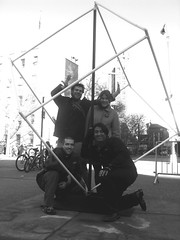
group cube
Originally uploaded by Xavier de San Diego.
(I'm not sure what's going on here.)
Remember the Alamo? After Eight Months, the Astor Place Cube Comes Back
"I actually thought we would put it on this post and we’d turn it to the position we wanted it and then stick it like that." But it was never bolted in place. In any case, "I did not realize that the turning was such a factor in people’s enjoyment of it."
People just love that thing. I didn't realize I had an emotional attachment to it until I walked by one morning and saw it covered with some type of sheeting. I thought something was going to happen to it and got very upset.
A line of Kerouac clothing will hit stores soon, including dinner jackets. It is inspired by his sense of style, if not the jeans and khakis he actually wore.
Lowell Sun Online - Why is Kerouac on Lowell's back burner?
"Excuse me. Are those Kerouac™ jeans you're wearing?"
Apple's Front Row Comes Closer to Couch-Driven Computing
Where most of the computer industry trudges on under a banner of "more" -- more processor speed, more expansion ports, more stickers on the front of the computer -- Apple's mission statement amounts to "less." It is one of the few companies in the business that understands editing -- how the discipline imposed by having to remove yet another button, menu and toolbar can yield simpler, easier and more useful products.
Playlist: The iPod’s interface could be even better
iTunes has those lovely little Arrow icons next to a track’s name that, if Option- or Alt-clicked, take you to the entry and its surrounding album tracks if you’ve sorted tracks by album. I’d be thrilled if there was some way to open an album or artist entry from within a track’s Now Playing screen on an iPod.
This is the outstanding feature iPod needs most.
Star Wars: Episodes I-VI - The greatest postmodern art film ever. By Aidan Wasley
Emperor Palpatine, the embodiment of the Dark Side, taunts the despairing Luke in Return of the Jedi, "Everything that has transpired has done so according to my design," and we are led to understand in Sith that it was Palpatine himself who set the entire plot in motion by manipulating the Force toward Anakin's virgin birth. Palpatine is the emblem of the artist as clockmaker or puppet master, the omniscient manipulator of his hapless characters for the purposes of a satisfying narrative payoff. At the end of Jedi, in a scene out of Pirandello or one of Ashbery's own plays, the characters assert their autonomy and kill their author.
Crowds ogle Ma-Mail, a bioengineered plant that grows from a seed after five days of watering to reveal a message -- "I love you" or "Good luck" -- emblazoned on a sprout.
New communication style: Ma-Mail. 1. Open. 2. Water. 3. The Message. I love you; good luck!
New Orleans bloggers: Looka!, The Inderdictor.
Why does O'Reilly (of all organizations) use 'weblog' wrong?
Think about these things, reader. Don't sigh and turn the page. Think that I have written them and you have read them, and the odds against either of us ever having existed are greater by far than one to all of the atoms in creation.
From Roger Ebert's review of Kieslowski's Red.
"Sometimes, you're able to create a very distinct voice . . . from just the pace of their speech," Dale says, eyes twinkling, his voice drifting into the cadence of south London. "Did you know. That Michael Caine. Can only speak. In three words. At one time.
Poynter Online - Harry Potter And The Imbalance of Race
I'm sure she's a fine person. I'm saying she should stop writing as though white is normal and needs no identification, while every other race is so one-dimensional that a single word — black — sums up shade of skin, expression of eyes, length of nose, color of hair. She should describe my black friends with the same gifts of language that she uses on the white people.
George W Bush was in my dream last night. He was riding around on a motorcycle wearing a disguise depositing large sacks of I don't know what, while I was urgently trying to escape from a sprawling amalgam of office complex and amusement park. It's disconcertingly invasive to see his face appear unbidden in my mind, the jerk.
When sounds first enter the brain, they activate a region near the ears called the primary auditory cortex that starts processing sounds at their most basic level. The auditory cortex then passes on signals of its own to other regions, which can recognize more complex features of music, like rhythm, key changes and melody.
These music-processing regions may be continually looking for signals in the brain that they can interpret. When no sound is coming from the ears, the brain may still generate occasional, random impulses that the music-processing regions interpret as sound. They then try to match these impulses to memories of music, turning a few notes into a familiar melody.
For most people, these spontaneous signals may produce nothing more than a song that is hard to get out of the head.
Research into musical hallucinations is illuminating the phenomenon of the song that gets stuck in your head. My four-year-old was afflicted recently — he looked up from a construction project to say, in a bewildered tone, "Now all I can think about is Elvis."
Washington Post: Patrols on Mass Transit Intensified but Scattered
At L'Enfant Plaza, Metro officers displayed their submachine guns for a phalanx of television crews from around the world. They walked through the station, sweat pouring onto their backs from beneath their bulletproof vests.
One stepped to the side to check a trash can. Another tried the knob on a door to make sure it was locked. A third looked for anything unusual near the fareboxes. They fanned out when they reached the mezzanine, some taking position next to escalators, others staring down at passengers and the rest sweeping the platform.
An astute bit of journalism points out that, in response to the London bombings, USA's first order of business was to get pictures of guns on our subway to the media. Images of security now stand in for the real thing. Are they going to shoot the bombs?
For most of history, journalists could afford to spend their time covering wars, famines, politics and business. The reason for this is that everyone knew where the white women were at - at home, probably in the kitchen, minding the kids.
Burritoeater: “Is it as fun as skimming rocks on a frozen lake? If you imagine that the rocks are burritos and the lake is our systematic, fully thawed engine of analysis, then yes, it is.”
I see a video iPod strategy behind Apple's embrace of podcasting. iTunes 4.8 was the first version of iTunes to handle video files. The RSS enclosure format has always supported delivery of movies (as well as any other type of attachment, I assume). The pieces are coming together -- although Steve Jobs has famously dismissed the idea of watching movies on an iPod as impractical, I can certainly imagine watching a BBC News summary, a Pixar short, a cooking demonstration, or a slew of movie trailers on the subway ride to work. If videoblogging takes off, it will give Apple a legitimate content pool that will justify releasing a video iPod.
"My audience has gone from being over 95 percent Black 10 years ago to over 95 percent white today," laments Boots Riley of the Coup. "We jokingly refer to our tour as the Cotton Club," he says — a reference to the 1920s and '30s Harlem jazz spot where Black musicians played to whites-only audiences.
...
"I love Boots Riley's music, but in general people in the 'hood are not checking for the Coup," says Brother Ali, part owner of the Minneapolis-based hip-hop collective Rhymesayers Entertainment. "It's hard enough to get some of our people to go to a Kweli show. It has a lot to do with the fact that the emphasis on the culture has been taken away. It's just the industry now and it's sold back to us — it's not ours anymore. It used to be anti-establishment, off the radar, counterculture. People in the streets are now being told what hip-hop is and what it looks like by TV."
Village Voice: The Cotton Club by Bakari Kitwana .